Black oud is one of the rarest, most expensive natural ingredients on earth. Pricier per pound than gold. Embedded in cultures from the Gulf to Japan for over a thousand years. The fragrance of kings, prophets, and emperors.
If you've heard the name and wondered what makes black oud so special — this is the complete guide. What it is, where it comes from, how it smells, what it does, and why it's worth what it is.
Black oud is a dark, resinous wood produced by the Aquilaria tree when infected by a specific mould. The infection triggers the tree to produce a thick, fragrant resin that hardens within the heartwood — this resinous wood is harvested, distilled, and used to create the world's most prized natural fragrance. Only around 1 in 10 trees produces oud, making it rarer and more expensive than gold by weight.
Known across the Middle East and Gulf as "black gold", black oud is derived from the subtropical Aquilaria tree — an evergreen agar tree found across Northeast India, Bangladesh, and Southeast Asia.
The process begins when the tree is damaged and becomes infected by a mould called Phialophora parasitica. To protect itself, the tree produces a thick, dark, scented resin that saturates the heartwood. Over time this resin hardens, creating the precious dark wood we know as oud.

Only around 1 in 10 wild trees produces oud naturally. The infection is rare. The wait is long — sometimes decades. Replicating the process artificially is extremely difficult. This is why oud commands a higher price per pound than gold.
To create oud oil, the resinous wood is soaked in water, then distilled at low temperatures. The resulting oil is dried in sunlight to evaporate excess moisture. The entire process is a craft passed down through generations — high-quality oud production is closer to artisanship than industry.
Demand has put the Aquilaria tree on endangered lists. Sustainable cultivation is now essential, and the most ethical oud producers grow their trees on dedicated plantations.
Yes. "Oud" and "oudh" are alternative spellings of the same ingredient — the romanisation of the Arabic word عود. You'll see both spellings used interchangeably across luxury perfumery and the Middle East. "Black oud" simply refers to oud at its most concentrated and aged form, prized for its depth and complexity.
Oud has a history as rich as its scent. References appear in the Sanskrit, the Torah, the Bible, and Islamic scripture. The Prophet Muhammad is said to have used oud to perfume his clothes and referenced agarwood's place in Paradise.

The Pharisee Nicodemus is described in the Gospel of John as wrapping the body of Jesus after the Crucifixion with linen and spices, including oud.
The Roman physician Dioscorides documented agarwood's medicinal uses in his pharmacopoeia Materia Medica in 65 CE. Some traditions suggest agarwood was the only cutting Adam took from the Garden of Eden.
The wealthiest ancient Chinese had their coffins carved from agarwood. In Buddhism, the most sacred prayer beads — the 108-bead mala — are traditionally crafted from this resinous heartwood.
As oud spread to Europe, royalty embraced it. Louis XIV of France — known as the Sun King — was said to wash his clothes in a blend of oud and rose daily. (He was also famously terrified of bathing.) Prince William reportedly received a bespoke oud-based fragrance on his wedding day in 2011.
From the deserts of Arabia to the courts of Versailles, oud has been the fragrance of those who command attention.
Oud's uses span the spiritual, the cosmetic, and the everyday across multiple cultures.
Agarwood chips, called bakhoor, are burned to perfume textiles, scent the home, and mark special occasions. Wedding ceremonies. Family celebrations. Religious gatherings. The smoke is said to carry both scent and blessing.
 Incense in Mosques
Oud incense is widely burned in mosques across the Muslim world. The scent is associated with sacred spaces, prayer, and reverence. For many, it's the smell of home — exiles often report missing oud most of all.
Oud oil is dabbed behind the ears, on the wrists, and on the neck. Unlike alcohol-based perfumes, oud lingers for hours — sometimes days — and changes subtly as it interacts with the wearer's skin.
Oud is one of the most prized gifts across the Middle East. Given to honoured guests, family members, business partners, and dignitaries. The presentation matters as much as the scent.
Describing oud is difficult. The scent is layered, evolving, and deeply personal. The most common descriptors:
What makes oud unique is its evolution. On first contact, oud often reads as smoky and earthy. Over the next hour, sweeter notes emerge — warm honey, soft amber, hints of dried fruit. Over the rest of the day, it deepens into a velvety musk that becomes inseparable from your skin.
This is why oud is described as "alive" — it doesn't smell the same on any two people, or even on the same person twice. It reacts to your skin's chemistry, body heat, and natural pheromones to create something genuinely your own.
For interiors, oud creates an atmosphere of opulence. Burning oud incense in a room transforms it — the closest comparison for those unfamiliar might be the burning of frankincense in Catholic masses, but deeper, warmer, and more intimate.
Our Black Oud Eau de Parfum opens with smoky, woody notes — the unmistakable signature of real oud. The heart deepens into warm spice and resin. The base settles into a rich, masculine musk that lingers for hours. Built around real Black Oud, formulated in England, small-batch.
Shop Black Oud EdP → Browse Fragrance →
For thousands of years, oud has been used in traditional medicine across multiple cultures. The Prophet Muhammad outlined seven medicinal uses of oud, and modern research continues to investigate its therapeutic properties.
Contemporary research and aromatherapy practice has identified additional benefits:
Oud oil is also studied for its potential as a muscle relaxant, fever reducer, and natural antidepressant. The science is catching up with what traditional medicine has known for centuries.
Oud's skincare benefits have driven its rising popularity in the luxury beauty industry.
This is why oud features in serious skincare formulations — not for marketing, but because the ingredient genuinely works.

Oud oil delivers the same skincare benefits to the scalp and beard hair. The Sanskrit poet Kālidāsa (c. 353–c. 420 CE) wrote of women who "suspend their dark hair in the smoke of burning aloes" — aloes being the ancient word for agarwood.
For modern beard wearers, oud beard oil delivers three core benefits:
Combined with the unmistakable scent of real oud, an oud-based beard oil sits in a different category from generic beard oils. Our Black Oud Beard Oil is built on this principle — small-batch British formulation, real Black Oud, no shortcuts.
Shop Beard Oil → Browse Beard Collection →
The short answer: rarity, time, and process.
This is why genuine oud-based fragrances cost what they do. Most "oud" perfumes on the high street use synthetic oud accords because real oud would push the price beyond what the mass market accepts. Real oud — the kind sourced for ZOUSZ Black Oud — is reserved for those who understand what they're paying for.
Oud is generally well-tolerated when burned as incense, used as essential oil, or applied externally. Some considerations:
For everyday wear as fragrance, applied to skin or used as bakhoor — oud is safe, time-tested, and woven into daily life across the Muslim world for over a millennium.
"Black oud" refers to the most concentrated, aged form of oud — typically darker in colour with deeper, smokier scent profiles. Regular oud can range from pale gold to dark brown. Black oud is at the premium end of the oud spectrum.
Real black oud fragrance lasts significantly longer than synthetic alternatives. A quality oud Eau de Parfum can be detectable on the skin for 10-12 hours, with the scent evolving throughout the day.
Oud's deep, woody, animalistic profile aligns with traditional notions of masculine fragrance. Historically, oud was worn by sultans, kings, and warriors across the Muslim world. Today, modern oud fragrances are worn by all genders — though men's fragrances continue to feature oud most prominently.
Generally yes, but always patch test first. Quality oud is well-tolerated, but as with any concentrated fragrance ingredient, individual sensitivity varies.
Real oud has depth and complexity that synthetic recreations cannot match. The scent evolves dramatically on the skin over time. Synthetic oud tends to smell flat, plasticky, and stays consistent. Real oud is also significantly more expensive — if a fragrance claims to be oud-based and costs under £30, it's almost certainly synthetic.
None. They're alternative spellings of the same Arabic word. "Oud" is the more common Western spelling, "oudh" is closer to the original Arabic pronunciation.
Because there's no shortcut to depth. ZOUSZ Black Oud is built around real, sustainably sourced black oud — the most concentrated, complex form of the ingredient. Small-batch, British-formulated, no synthetic substitutes. The fragrance you smell is the fragrance the agar tree produced, refined to wear on skin.
Reading about oud is one thing. Wearing it is another. ZOUSZ Black Oud captures the depth, history, and presence of real oud in a fragrance crafted for daily wear — not for special occasions, but for the man who understands that real luxury is felt, not announced.
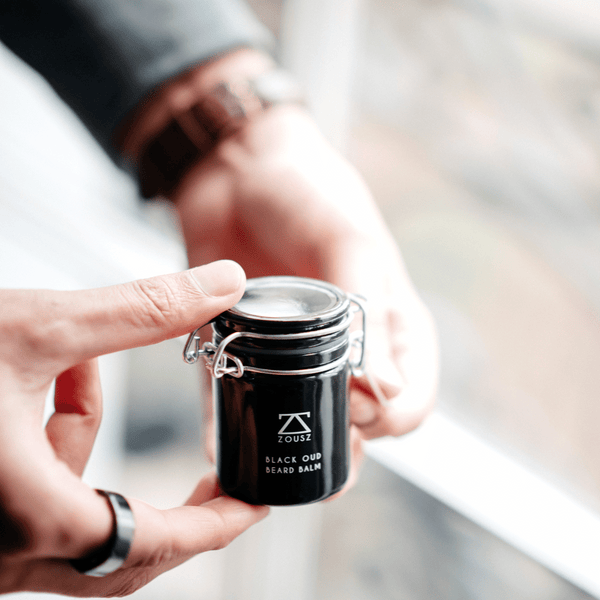
Browse the full Black Oud collection — Eau de Parfum, beard oil, beard balm, beard shampoo — all built around the same precious resin that's been worn by kings for over a thousand years.
I want to know the benefits of black oud perfume